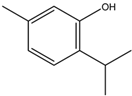
PubChem CID 6989 – Thymol (also known as 2-isopropyl-5-methylphenol, 5-methyl-2-isopropylphenol, thyme camphor, isopropyl cresol, and related phenolic derivatives).

PubChem CID 6989 – Thymol (also known as 2-isopropyl-5-methylphenol, 5-methyl-2-isopropylphenol, thyme camphor, isopropyl cresol, and related phenolic derivatives).
| Boiling Point | 232°C |
| Melting Point | 51°C |
| Color | White |
| Formula Weight | 150.22 |
| Physical Form | Crystal-Lump at 20°C |
| Chemical Name or Material | Thymol |
| UN Number | 1759 |
Classification of the substance or mixture
GHS Label elements, including precautionary statements
Hazards not otherwise classified (HNOC) or not covered by GHS
GHS Classification in accordance with 29 CFR 1910 (OSHA HCS). For the full text of the H-Statements mentioned in this Section, see Section 16.
Signal word :
"Sarchem Labs provides top-quality chemicals that meet the highest industry standards. Their reliable supply chain, excellent purity levels, and prompt customer service make them our go-to partner for research and production needs."
"We trust Sarchem Labs for their high-purity reagents and chemicals. Their extensive product catalog and fast shipping ensure that we always have what we need for our laboratory experiments without delays."
"Sarchem Labs stands out for its commitment to quality, safety, and customer satisfaction. Their chemicals are consistently reliable, and their support team is always ready to assist with any inquiries. Highly recommended!"
The melting point of thymol is between 49 and 51°C. This feature is crucial in determining its purity and stability for many uses, including medications, antiseptics, and flavouring agents.
The thymol chemical structure comprises an isopropyl (-C3H7) group at particular locations and a phenol ring with a hydroxyl (-OH) group. This molecular configuration helps to explain its fragrant and antibacterial qualities.
Thymol's chemical formula is C10H14O. This composition reflects its molecular structure, which consists of ten carbon atoms, fourteen hydrogen atoms, and one oxygen atom. Therefore, it confers antibacterial and therapeutic effects.
Boiling point of thymol ranges from 232 to 233°C. This temperature characteristic determines its volatility and appropriateness for different industrial and medicinal uses.
Molecular weight of thymol of 150.22 g/mol. This value depends on accurate measurements in chemical formulations and laboratory use that require exact computations.